Research & IP
CEO Genome®
Research on the four leadership behaviors most strongly associated with CEO success.

Research on the four leadership behaviors most strongly associated with CEO success.
leader assessments informed the research
CEOs analyzed
years of assessment data
What predicts CEO success? CEO Genome research points to four specific, learnable behaviors rather than the traditional markers of charisma, pedigree, or confidence.
What separates CEOs who excel from those who falter? It is a question worth approximately $112 billion a year – the estimated cost shareholders bear when boards select the wrong chief executive. Roughly one in four Fortune 500 CEOs who depart each year are forced out, signaling that even the most sophisticated selection processes frequently miss the mark.
The CEO Genome project set out to answer that question using data. Led by ghSMART in partnership with economists Professor Steven N. Kaplan at the University of Chicago and Professor Morten Sørensen at Copenhagen Business School, along with data scientists at SAS, the research team assembled one of the world’s most comprehensive leadership data sets: more than 17,000 C-suite executive assessments – including over 2,000 CEOs – spanning every major industry sector and company sizes ranging from the Fortune 100 to $10 million businesses.
Each assessment draws on four-to-five-hour structured interviews conducted by senior consultants using the Who Method, capturing detailed career histories, behavioral patterns, decision-making approaches, and performance outcomes. In many cases, these are supplemented by 360-degree feedback from colleagues, board members, and business associates. The data set also includes a focused sample of 930 CEO candidates analyzed across 19 of 20 NAICS industry sectors, plus 70 exclusive interviews with CEOs and board members and an in-depth study of more than 70 CEO firings.
 The research brought together multiple disciplines and data sources. A cross-disciplinary team of 14 researchers – spanning psychology, economics, statistics, financial markets, and data science – applied analytical techniques used in fraud detection and financial modeling to identify behavioral patterns associated with CEO performance. The analysis identified a consistent pattern: successful chief executives consistently demonstrate four specific, measurable behaviors. These behaviors, not personality traits or pedigree, are the strongest predictors of who will thrive in the corner office.
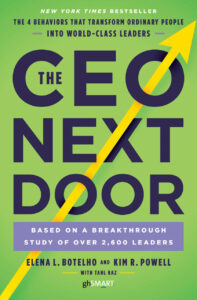
The findings were published as a cover article in the May/June 2017 issue of Harvard Business Review – 4 Things That Set Successful CEOs Apart by Elena L. Botelho, Kim Powell, Stephen Kincaid, and Dina Wang – and has since been downloaded more than 250,000 times globally. The full research was expanded in the New York Times and Wall Street Journal bestseller The CEO Next Door by Elena L. Botelho and Kim R. Powell.
The CEO Genome research identifies four behavioral patterns – known collectively as the DARE framework – that consistently distinguish high-performing CEOs from their peers: Decide with speed and conviction, Adapt proactively, Reliably deliver, and Engage for impact. These are not fixed personality traits. They are observable, measurable, and – crucially – developable competencies that leaders can build at any stage of their career.
The research also examined what happens when these behaviors are weak or absent. Each DARE behavior carries a powerful success multiplier when present – but its absence is equally revealing. Weakness in any single behavior accounts for a significant share of CEO failures, with gaps in decisiveness (38%) and stakeholder engagement (35%) representing the two most common causes of executive derailment.
The research reveals that decisive CEOs are twelve times more likely to be high performers than those who hesitate. Conversely, 38 percent of CEO failures trace back to a lack of decisiveness – the single largest behavioral driver of executive derailment. the behavior that most differentiated top-performing CEOs was not analytical brilliance, visionary thinking, or even sound judgment – it was the willingness to make decisions with speed and conviction, even amid ambiguity.
Decisive leaders are propelled by a distinctive sense of responsibility. They recognize that in many situations, a potentially wrong decision made promptly outperforms the absence of a decision. Their teams and organizations depend on clear direction to execute. Delays at the top can slow decisions and execution throughout the organization.
The data underscores this pattern: 94 percent of executives who scored poorly on decisiveness had erred by deciding too slowly, not by making reckless calls. High performers move faster by simplifying complexity – building mental models that cut through noise and focus on the most important drivers of their business. They give stakeholders a voice in the process but do not seek consensus. And they make fewer decisions overall, concentrating their attention on the choices that matter most while delegating others down the organization.
Critically, decisive CEOs treat mistakes as a learning system rather than evidence of failure. They build processes to review past decisions, extract lessons, and refine their judgment over time. CEO candidates who spoke openly about their setbacks as learning opportunities were twice as likely to deliver strong performance compared to those who avoided the word “failure” entirely.
CEOs who proactively adapt to changing conditions are roughly seven times more likely to succeed than those who wait for disruption to force their hand. While only 16 percent of CEO failures are currently attributed to gaps in adaptability, this figure is widely expected to rise: adaptability is the behavior that boards and investors increasingly prioritize as the pace of industry change accelerates. The average life span of today’s leading companies has contracted from sixty-five years to roughly twenty-three years, increasing the importance of leaders who can adapt to changing conditions.
The most adaptable CEOs in the data set share a distinguishing quality identified by a Navy SEAL officer as the single trait that separates good leaders from great ones in unpredictable environments: humility. These leaders recognize what they do not know. They are willing to release strategies, business models, and even personal habits that have driven past success but no longer serve the organization’s future.
Research by Cambridge University professor Sucheta Nadkarni, conducted in collaboration with the CEO Genome® team, examined 221 firms across 19 industries over a seven-year period. The findings showed that companies led by CEOs who focused more heavily on the future – rather than the past or present – were the ones that introduced new products faster and adapted more effectively to industry shifts. The CEOs in the study who demonstrated the strongest future orientation spent more than 40 percent of their time on long-term thinking, compared to roughly 20 percent for other senior executives.
Adaptable CEOs build what the research calls an “antenna for the future” through four practices: cultivating diverse information networks outside their industry, asking probing questions rather than providing answers, running premortems to anticipate failure scenarios before they unfold, and immersing themselves directly in customer experience. These leaders actively seek novelty, weigh roles for their learning potential as much as their title, and develop the skills they lack even when doing so feels uncomfortable.
Among the four CEO Genome behaviors, Reliability was a strong differentiator. It is the only behavior that simultaneously increases both a candidate’s likelihood of being hired and their odds of excelling in the role. CEOs known for being reliable are fifteen times more likely to be high performing, and their odds of getting hired are double those of the average candidate. At the same time, only 11 percent of CEO failures are attributed to gaps in reliability – the lowest proportion of any DARE behavior – suggesting that those who lack this trait are typically screened out before reaching the role, underscoring how heavily boards weight it in selection.
Reliability in this context goes far beyond simply meeting deadlines. It encompasses personal consistency – showing up with the same temperament, standards, and follow-through regardless of circumstances. In the sample studied, 94 percent of the strongest CEO candidates demonstrated consistent follow-through on their commitments. The research also found that 75 percent of strong CEO candidates scored high on organization and planning skills, and that CEOs were nearly twice as likely as average senior leaders to be strong in holding people accountable for results.
The pillars of executive reliability are personal consistency, setting realistic expectations, practicing radical personal accountability, and building systems of consistent process. Boards and shareholders place enormous value on predictability of outcomes. When faced with a choice between a mercurial visionary and a consistently dependable operator, most boards choose the leader whose performance can be predicted quarter after quarter.
Reliable leaders also embed these practices into their organizations. They build management systems – scorecards, cadences of accountability meetings, clear metrics – that transform individual reliability into institutional capability. This operational discipline creates the foundation that makes the other three behaviors possible.
Despite their authority, CEOs are almost entirely dependent on others to deliver results. The CEO Genome research found that two out of every three highly independent CEOs are likely to underperform expectations. Interdependence, not independence, is the defining characteristic of effective executive leadership. When this behavior is absent, the consequences are severe: 35 percent of CEO failures are attributed to weak stakeholder engagement – the second-largest behavioral driver of derailment. When it is present, CEOs are twice as likely to succeed.
The data further reveals that CEOs who engaged stakeholders around results were 75 percent more successful than those who relied primarily on interpersonal warmth or likeability. The distinction matters. While likeable candidates are more likely to get hired, likeability alone correlates with suboptimal performance. The most effective leaders occupy a “Goldilocks zone” between being too agreeable and too abrasive – engaging with empathy and respect while maintaining an unwavering focus on outcomes.
CEOs who engage for impact share three practices. First, they lead with intent: they clearly articulate their aspirational goals and translate those goals into specific, actionable expectations for every interaction. Second, they master perspective getting – actively working to understand the emotional, financial, and practical needs of each stakeholder group rather than projecting their own assumptions. Research from the University of Chicago found that introverts in the data set were slightly more likely to outperform expectations, likely because their natural inclination toward listening and preparation supports this form of deep stakeholder understanding. Third, they build routines – consistent, repeatable habits of communication and engagement that keep their organizations aligned.
The CEO Genome data challenges several common assumptions about who becomes a successful CEO and how. Among the most significant findings:
Elite educational pedigree was not a prerequisite for strong CEO performance. Only 7 percent of the CEOs in the data set attended an Ivy League institution, and 8 percent did not complete college at all. Outside the narrow slice of Fortune 500 leadership, educational background shows no meaningful correlation with CEO performance.
Extroversion was not a prerequisite either. Over a third of high-performing CEOs in the sample described themselves as introverts, and self-identified introverts were slightly more likely to exceed board expectations than extroverts. High confidence, while it may help a candidate get hired, shows no statistical advantage in the role itself.
A flawless résumé was not a prerequisite. Forty-five percent of CEO candidates in the data set had experienced at least one significant career blowup – being fired, making a costly mistake, or presiding over a failed initiative. Yet 78 percent of those who experienced such a blowup ultimately won the top job. The differentiator was not the absence of failure but how candidates handled it. Those who took ownership and framed setbacks as learning opportunities were dramatically more successful than those who deflected blame. Candidates who attributed failures to others saw their hiring prospects drop by a third.
Prior CEO experience was also less predictive than many assume. First-time CEOs in the sample were statistically no less likely to meet or exceed expectations than seasoned executives – one of the more counterintuitive findings in the entire study. And gender had no statistically significant impact on CEO performance; successful CEOs of all genders exhibited the same four behavioral patterns.
Beyond identifying the behaviors that drive performance, the CEO Genome® research analyzed the career trajectories of nearly a thousand CEO journeys to understand how leaders reach the corner office – and what separates those who arrive faster from those who take a longer path.
One finding stood out: over 70 percent of CEOs did not set out to become chief executive until late in their careers, typically after fifteen or more years of professional experience. The stereotypical linear ascent through elite institutions and marquee companies is the exception, not the rule. On average, CEOs in the sample took roughly 24 years to reach the role, held 8 to 11 positions across 4 to 6 companies, and accumulated approximately 11 years of general management experience before their first CEO appointment.
The research team closely studied a subset of leaders they call “Sprinters” – those who reached the CEO chair faster than average. Nearly 97 percent of Sprinters had undertaken what the researchers term Career Catapults: inflection-point experiences that accelerated their capabilities and visibility in the eyes of boards and investors.
Three types of Career Catapults emerged from the data:
The research also identifies three career stages that most CEO trajectories follow: going broad in the first eight years to build diverse functional exposure, going deep from roughly years nine through sixteen to demonstrate measurable results and leadership ability in a specific domain, and going high from years seventeen to twenty-four to differentiate themselves as enterprise-level leaders who influence outcomes beyond their immediate scope of authority.
The CEO Genome research has direct implications for how boards select and develop chief executives.
Traditional CEO selection relies heavily on subjective impressions – charisma in an interview, the polish of a résumé, the familiarity of a candidate’s background. The research demonstrates that these surface markers are poor predictors of performance and often introduce systematic bias. The data shows, for example, that candidates who speak with a pronounced accent are twelve times less likely to be hired as CEO, despite accent having no correlation with leadership effectiveness.
The CEO Genome framework gives boards a more evidence-based way to evaluate candidates. By evaluating candidates against the four behavioral criteria – decisiveness, engagement for impact, reliability, and adaptability – selection committees can focus on the competencies that actually predict success. ghSMART’s independent analysis of its assessment methodology shows an accuracy rate of approximately 90 percent in predicting candidate performance, compared to an estimated 50 percent error rate in conventional executive hiring processes.
For succession planning, the framework enables boards and CHROs to identify high-potential internal candidates years before a transition, evaluate them against behavioral benchmarks that predict CEO success, design targeted development programs that strengthen specific behavioral gaps, construct a Future CEO Scorecard that aligns required leadership capabilities with company strategy and context, and monitor candidate readiness through ongoing assessment rather than relying on a single high-stakes evaluation.
The research also highlights that context matters. The relative importance of each CEO Genome behavior varies by industry, company size, and strategic moment. A technology startup navigating rapid market shifts may need to weight adaptability most heavily, while a healthcare organization may prioritize reliability above all else. Effective succession planning matches behavioral strengths to the specific mandate a new CEO will face.
For investors – particularly private equity firms evaluating management teams – the CEO Genome behaviors offer a structured due-diligence lens. Assessing whether a portfolio company’s leadership team demonstrates the right behavioral profile for the value-creation thesis at hand can strengthen leadership due diligence around the value-creation plan.